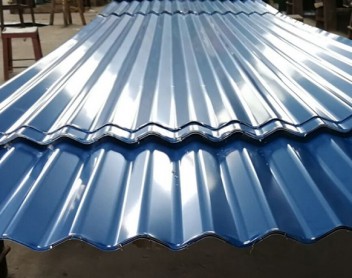
GI corrugated sheet, also known as galvanized steel corrugated sheet, is a wavy steel plate that has undergone hot-dip galvanizing treatment to form a zinc protective layer on its surface. It is not only an indispensable core material in modern industrial construction, but also shines in various fields such as infrastructure, warehousing and logistics due to its outstanding performance. Its unique wavy structure is not just for aesthetics, but also a clever mechanical design that greatly enhances the stiffness and load-bearing capacity of the board, allowing it to maintain excellent stability even in large spans.

1. The core components of GI corrugated sheet: substrate and coating
To gain a deeper understanding of GI corrugated sheet, one needs to start with its two basic components: the substrate and the galvanized layer.
(1) Substrate (steel strip): High quality low-carbon steel is usually used as the raw material. This type of steel has good plasticity and weldability, and can be easily processed into various wave heights and distances through cold bending forming technology. The thickness of the substrate (usually 0.3mm to 1.2mm) directly determines the final strength and weight of the board.
(2) Galvanized layer: This is the core of the anti rust ability of GI corrugated sheet. The manufacturing process involves immersing the cleaned steel strip into a molten zinc solution at approximately 450 ° C, and through a series of reactions, forming a dense layer of zinc iron alloy and pure zinc on the surface of the steel strip. This galvanized layer provides two crucial protection mechanisms for the steel plate below:
Physical barrier protection: The dense zinc layer effectively isolates the steel plate from corrosive media such as moisture and oxygen in the air, like putting a "protective suit" on the steel plate.
Electrochemical protection (sacrificial anode protection): The chemical properties of zinc are more reactive than iron. When the galvanized layer is partially damaged and the internal steel base is exposed, zinc will preferentially corrode as the anode, thereby protecting iron as the cathode from damage. This "self sacrificing" characteristic ensures that even if there are cuts or scratches on the edge or surface of the board, the surrounding zinc layer can continue to provide protection, preventing rust from spreading inward.
The thickness and quality of the galvanized layer are usually measured by the "galvanizing amount" (unit: g/m 2), for example, the double-sided galvanizing amount is 180g/m 2. The higher the galvanizing amount, the longer its theoretical corrosion resistance life.
2. The outstanding characteristics and advantages of GI corrugated sheet
The reason why GI corrugated sheet is widely used is due to its combination of various excellent properties.
(1) Excellent corrosion resistance: Thanks to the dual protection mechanism of the galvanized layer, GI corrugated sheets can effectively resist corrosion in atmospheric environments and have a much longer service life than ordinary steel plates. In general industrial and rural environments, its service life can reach 20-30 years.
(1) High strength and lightweight: The corrugated geometric structure endows the board with extremely high mechanical strength (especially bending strength) and stiffness. This means that under the same load, GI corrugated sheets can be made thinner and lighter, thereby reducing the overall load of the building structure, lowering the material cost of the supporting structure, and facilitating transportation and installation.
(2) Excellent durability and impact resistance: The steel plate substrate itself has good impact and wear resistance, and can withstand certain external impacts. The high-quality galvanized layer has strong adhesion and is not easy to peel off, ensuring its long-term protective effect.
(3) Economy and convenient construction: Compared to traditional materials such as concrete, GI corrugated sheet has a high cost-effectiveness. It is lightweight and has a simple and fast installation process. It is usually connected with bolts or self tapping screws, which can greatly shorten the construction period and save labor costs. In addition, standardized dimensions and waveforms also facilitate design and procurement.
(4) Multifunctionality and plasticity: GI corrugated sheets can be easily cut, bent, and punched as needed to meet different design requirements. Its surface can also be coated with colored organic coatings, which not only maintain its anti-corrosion performance but also provide a wide range of color choices to meet the aesthetic requirements of architecture.


3. Key technical parameters and classification of GI corrugated sheet
When choosing GI corrugated sheet, it is important to pay attention to the following key parameters, which together determine the performance and applicable scenarios of the board.
|
Parameter Category
|
Specific Parameter
|
Description and Impact
|
|
Substrate Parameters
|
Material
|
Usually low-carbon steels with grades like Q195 and Q235, which affect strength and formability.
|
|
Thickness
|
Directly affects the load-bearing capacity and weight of the sheet, and is one of the key factors determining the price.
|
|
Coating Parameters
|
Zinc Coating Amount (g/m2)
|
Such as Z60, Z80, Z180, etc. The higher the value, the better the corrosion resistance generally is.
|
|
Spangle Size
|
Options include normal spangle, small spangle, and zero spangle, mainly affecting appearance with little impact on performance.
|
|
Coating Parameters
|
Wave Height (mm)
|
The height of the corrugation, which affects drainage capacity and lateral stiffness.
|
|
Wave Pitch (mm)
|
The distance between two wave crests, which, together with wave height, determines the mechanical properties of the sheet.
|
|
Effective Coverage Width
|
The actual coverage width between each wave crest after the sheet is laid.
|
According to whether subsequent treatment is carried out after the galvanized layer, GI corrugated sheets can be divided into:
(1) Smooth GI corrugated sheet: Only hot-dip galvanized, with a bright silver surface with zinc flower crystal patterns. Low cost, mainly used for industrial buildings, temporary facilities, etc. with low aesthetic requirements.
(2) Color coated GI corrugated sheet (colored steel tile): Apply one or more layers of colored coating (such as polyester, silicon modified polyester, PVDF, etc.) on top of the galvanized layer. Not only does it have rich colors, beautiful and durable appearance, but it also further enhances its anti-corrosion and UV resistance, and is widely used in public buildings, factories, warehouses, etc.
4. Main application areas
The characteristics of GI corrugated sheet make it play an important role in the following fields:
(1) Building enclosure system: This is the most traditional application field. As roofing and wall materials for industrial plants, warehouses, sports venues, and markets, they play a role in enclosure and shelter from wind and rain.
(2) Infrastructure field: used for constructing culverts, underground passages, temporary bridges, etc. Its lightweight and high-strength characteristics are particularly suitable for use in soft soil foundations or scenarios that require rapid construction.
(3) Warehousing and logistics: used for manufacturing partitions, shelves, equipment protective covers, etc.
(4) Agricultural architecture: used for livestock and poultry houses, greenhouses, etc., providing sturdy and durable shelter structures.
In summary, GI corrugated sheet is an engineering material that perfectly combines the strength of metal materials with the anti-corrosion advantages of galvanizing technology. The design of its corrugated structure is a manifestation of mechanical wisdom, while the galvanized layer endows it with long-lasting vitality. By understanding its composition, characteristics, technical parameters, and application scope, we can select and use this multifunctional material more scientifically and economically to meet diverse engineering construction needs.

 Language


 Address:Bo Xing County, Shandong Province
 E-mail: