Nanoplates and nanomaterials are conceptually related,but they are not completely equivalent.Nanoplate is a type of board material that is processed using nanotechnology or has nanoscale structural features,while nanomaterials refer to materials that are at least one-dimensional at the nanoscale(1-100 nanometers).The following analysis will be conducted from three aspects:definition,structural characteristics,and application scenarios.

1.Definition difference:Nanoplate≠Generalized Nanomaterials
The core standard for nanomaterials is at the nanoscale,including zero dimensional(such as nanoparticles),one-dimensional(such as nanowires),two-dimensional(such as nanofilms),and three-dimensional(such as nanoporous materials).The definition of nanoplates focuses more on the shape of the sheet,and their substrates may be metal,inorganic non-metal,or polymer materials,which introduce nanoscale characteristics through surface treatment or internal structural modification.
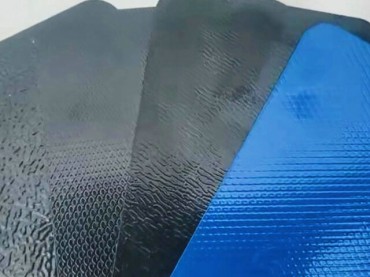
For example,in the suspended ceiling industry,nanoplates are mainly made of aluminum substrate,with a surface coated with nano silica to form a microporous structure to enhance thermal insulation performance;Nanoplates in the industrial field may be based on materials such as graphene and zinc oxide,and fabricated into two-dimensional structures through stacking or composite processes.Although this type of board contains nanoscale components,the overall scale may exceed the nanometer range,so a more accurate classification is nanocomposite materials or nanostructured boards.
2.Structural features:combination of nanoscale characteristics and macroscopic sheet materials
The key to nanoplates lies in their nanoscale functional layers or structures.Taking the nanoplate used for kitchen and bathroom ceilings as an example,its substrate is chemically degreased and pre treated with wire drawing,and then formed through three layers of polymer coating roller coating combined with short wave baking technology.The core material is 7-12 nanometer silicon dioxide.These nanoparticles form a microporous structure on the surface of the board,which can suppress heat conduction,convection,and radiation,thereby improving thermal insulation performance.
In the industrial field,graphene nanoplates are composed of double or multiple layers of graphene stacked together,and their two-dimensional structure endows the sheet with excellent mechanical and electrical properties.This type of nanoboard is prepared by chemical methods such as electrochemical deposition and hydrothermal method,and the internal interface effect leads to size dependent material properties,which are fundamentally different from macroscopic boards.

3.Application scenario:Differentiated development guided by functionality
The application of nanoplates is highly dependent on their nanoscale properties.For example,nanoplates for suspended ceilings have become the preferred choice for mid to high end kitchen and bathroom spaces due to their anti fouling,wear-resistant,and anti-static properties;Industrial nanoplates are widely used in fields such as microsensors,resonators,and high-efficiency energy-saving batteries due to their high thermal conductivity and strength.
On the other hand,the application of generalized nanomaterials focuses more on breakthroughs in fundamental properties.For example,nanoparticles are used for magnetic storage media,nanotubes are used for field-effect transistors,nano biosensors are used for drug delivery,and so on.These applications require higher requirements for pure nanoscale materials,while nanoplates emphasize the combination of nanoscale characteristics and sheet morphology.
Nanoplates are not strictly nanomaterials,but rather sheets processed through nanotechnology or possessing nanoscale structural features.Its value lies in combining the excellent properties of nanomaterials,such as thermal insulation,conductivity,and pollution resistance,with the macroscopic practicality of the board,expanding the application boundaries of nanotechnology.In the future,with the advancement of nanoscale preparation technology,the functionality and application scenarios of nanoplates will be further enriched,becoming an important bridge connecting nanoscience and engineering practice.

 Language


 Address:Bo Xing County, Shandong Province
 E-mail: