
 Language


More Language
Language
In modern architecture and industrial structures, steel plays an extremely important role. With the widespread adoption of lightweight steel structures, C-shaped steel has gradually become the preferred material for various engineering projects due to its lightweight, economical, and excellent performance characteristics. Whether used as roof purlins, wall studs, mechanical frames, or equipment supports, C-shaped steel demonstrates irreplaceable advantages.
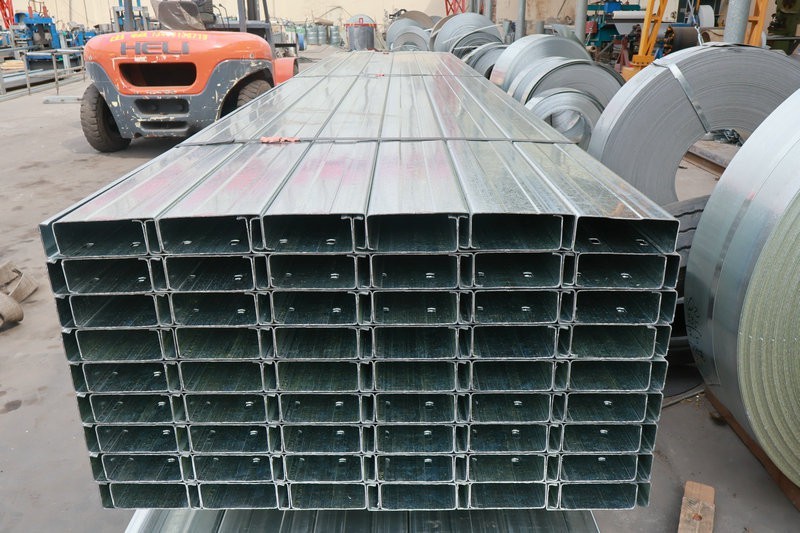
C-shaped steel is an open-section profile manufactured through hot-rolled or cold-rolled steel plate forming via roll-forming processes. Its cross-section resembles the letter “C,” offering lightweight properties combined with high load-bearing strength. The core characteristics of C-shaped steel are primarily reflected in the following aspects:
The open-section design enables C shaped steel to maintain strength while significantly reducing weight. Flanging reinforcement substantially enhances its bending resistance and structural stability. Compared to traditional I-beams or H-beams, C-shaped steel demonstrates superior performance under vertical loads.
C-shaped steel heights range from tens to hundreds of millimeters, with thicknesses adjustable to meet specific load-bearing requirements. This versatility makes it highly adaptable for diverse applications such as warehouse roofing, machinery frameworks, and interior ceilings.
The rational cross-section of C-shaped steel yields a higher section modulus per unit weight than traditional hot-rolled steel sections. Consequently, it requires less steel for equivalent load-bearing capacity, reducing material costs.

Strong Load-Bearing Capacity: The open cross-section design enhances load-bearing strength, effectively meeting structural integrity requirements.
Lightweight: Compared to other steel products, C-shaped steel is relatively lightweight. This reduces transportation and installation costs while lowering the overall building weight, thereby decreasing foundation load requirements.
Low Energy Consumption: The production process of C-shaped steel significantly reduces energy consumption, making it an environmentally friendly construction material that aligns with modern sustainable building principles.
High Strength: C-shaped steel exhibits outstanding tensile, compressive, bending, and shear strength, meeting the strength and stability requirements of complex structures.
Good Plasticity: C-shaped steel exhibits good plasticity, enabling it to withstand natural disasters like earthquakes and typhoons to a certain extent, enhancing building safety.
Excellent Mechanical Properties: C-shaped steel possesses superior mechanical properties, including good toughness, wear resistance, and fatigue resistance, ensuring structural stability and reliability during long-term use.
Standardized Dimensions: C-shaped steel is designed and manufactured according to standardized dimensions and shapes, simplifying installation and reducing on-site fabrication requirements.
Easy Processing: Its rational cross-sectional design facilitates cutting, welding, drilling, and other fabrication operations, improving construction efficiency.
Flexible Adjustment: Lengths can be flexibly adjusted to accommodate structures of varying sizes and shapes.
Material Savings: C-shaped steel offers an economical cross-section with a higher section modulus per unit weight than hot-rolled steel. This reduces component weight under equivalent loads, conserving materials.
Construction Convenience: The installation process for C-shaped steel is relatively simple and rapid, lowering construction complexity and costs.
Reusability: C-shaped steel exhibits excellent reusability, aligning with sustainable development policies.
C-shaped steel finds extensive use in construction and industrial sectors due to its superior properties.
Commonly employed as roof purlins and wall studs in light steel structure projects.
In large-span structures like logistics warehouses and factory roofs, C-shaped steel forms an integrated enclosure system with color-coated steel sheets—lightweight yet robust.
As enclosures or support frames for machinery, C-shaped steel ensures structural integrity while facilitating cable and pipeline routing.
It is extensively used in conveyor frameworks, automated assembly lines, and similar equipment.
Employed as studs for partition walls or suspended ceilings, it offers superior fire resistance, moisture resistance, and load-bearing capacity compared to traditional wooden studs.
They excel in scenarios requiring suspension of heavy equipment.
C-shaped steel is also commonly used in road guardrails, photovoltaic mounting structures, and billboard supports, demonstrating excellent stability and durability.
- Regular Inspection: Conduct annual checks focusing on loose bolts and surface corrosion. Tighten or repair any issues promptly.
- Rust Removal & Corrosion Prevention: Sand rusted surfaces and apply rust-proof paint. Repair damaged galvanized coatings with zinc spray to prevent corrosion spread.
- Cleaning: Regularly clear dust and debris from roof/wall purlins to avoid excessive load. Ensure ventilation and moisture protection for interior framing.
- Overload Prevention: Strictly prohibit stacking loads exceeding design capacity on C-channels. Distribute temporary material loads evenly.
- Extreme Weather Protection: Reinforce loose components before typhoons or heavy rains. Promptly remove snow accumulation to prevent structural deformation.
Scientific selection of C-shaped steels in practical engineering applications reduces costs and ensures safety.
Ordinary carbon steel offers cost-effective utility for standard environments.
In coastal or corrosive settings, opt for galvanized C-shaped steel or weathering steel grades to extend service life.
Select profiles based on span and load calculations to avoid over- or under-sizing.
Excessive dimensions lead to waste, while undersized components pose safety risks.
Welded connections provide robust permanence for long-term structures; bolted connections facilitate disassembly and modifications but require anti-loosening and anti-corrosion treatments.
Drilled holes and cut edges must be ground smooth to prevent stress concentration and cracking.
Structure must be stored and transported flat to avoid deformation.
C-shaped steel's 100% recyclability aligns with sustainable development requirements. Compared to concrete structures, C-shaped steel demonstrates clear advantages due to its high recycling rate.
With the widespread adoption of high-strength steel, C-shaped steel will further reduce section thickness while maintaining performance, lowering material consumption and advancing lightweight development.
The rise of prefabricated construction heightens demand for standardized profiles. C-shaped steel's uniform specifications facilitate factory-based mass production and rapid on-site assembly, aligning with future building industrialization trends.
Though unit prices may exceed some traditional materials, C-shaped steel's integrated advantages in construction efficiency, longevity, and maintenance costs deliver superior economic value over its entire lifecycle.
With its lightweight design, high strength, construction convenience, and favorable economic and environmental attributes, C-shaped steel has become an indispensable profile in modern construction and industrial manufacturing. Its applications are expanding across light steel structures, mechanical equipment, infrastructure, and interior decoration. As green energy efficiency and industrialized construction trends accelerate, the advantages of C-shaped steel will be further amplified, playing an increasingly vital role in future development.
China galvanized plate manufacturer: Boxing Shuangshengda Steel specializes in galvanized sheet, galvanized steel plate,Colour steel plate etc.We have a full range of product specifications and types, low prices, and more than 20 years of experience, worthy of your trust
 Address:Bo Xing County, Shandong Province
 E-mail: