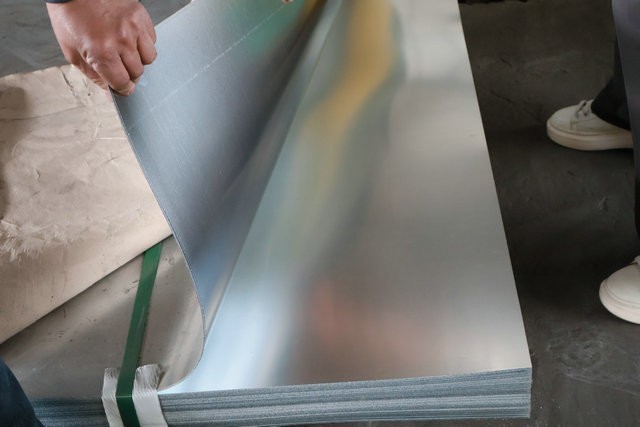
Galvanized plate is a metal material that achieves anti-corrosion by covering the surface of steel with a zinc layer. Its core value lies in achieving long-term protection at low cost, and it is widely used in fields such as construction, automobiles, and home appliances. From industrial grade protection with hot-dip galvanizing to precision processing with electroplated galvanizing, galvanized plates have reshaped the durability boundary of steel with the "zinc shield" technology.

1. Definition and classification: Process differences determine performance boundaries
The core of galvanized plate is the composite structure of steel and zinc, which can be divided into two categories according to the galvanizing process:
(1) Hot dip galvanized plate (GI): The steel sheet is immersed in a molten zinc solution at 450-460 ℃, where zinc and iron undergo diffusion reactions to form a 0.02-0.3mm thick zinc iron alloy layer. This layer is metallurgically bonded to the steel substrate, with an adhesion force of 5-10MPa and corrosion resistance 3-5 times that of electroplated zinc. For example, hot-dip galvanized plate steel used for wind turbine towers can maintain a 15 year corrosion free rating in high salt spray environments along the coast.
(2) Electroplated galvanized plate (EG): Zinc ions are deposited on the surface of the steel plate through electrolyte, forming a pure zinc layer with a thickness of 0.005-0.02mm. Its advantage lies in its high surface flatness (roughness Ra ≤ 0.5 μ m), which is suitable for scenarios with strict appearance requirements such as automotive interiors and 3C products. For example, the interior panels of Tesla Model 3 are made of electroplated galvanized steel, which remains rust free after 10 years of use.
(3) Alloyed galvanized plate (GA): After hot-dip galvanizing, rapid cooling forms FeZn7 phase (γ phase) in the zinc layer, increasing the hardness to HV180-220 and improving the wear resistance by 30%. This process is commonly used for easily worn parts such as automotive chassis and agricultural machinery. It can resist sand and gravel impact and has no perforation after 100000 kilometers of driving.
2. Protection mechanism: dual effects of zinc sacrifice and barrier
The corrosion resistance of galvanized plate is derived from the chemical properties and physical structure of zinc:
(1) Electrochemical protection: The electrode potential of zinc (-0.76V) is lower than that of iron (-0.44V), and it preferentially oxidizes in corrosive environments, forming a zinc oxide (ZnO) film. This film can prevent oxygen and water molecules from contacting the steel substrate. Experiments have shown that the galvanized layer can reduce the corrosion rate of the steel substrate by more than 90%. For example, in C3 corrosion environment (medium industrial area), the annual corrosion amount of un galvanized steel plate reaches 50 μ m, while galvanized steel plate is only 5 μ m.
(2) Physical barrier: The thickness of the zinc layer directly affects the protection life. According to ISO 1461 standard, the minimum local thickness of hot-dip galvanized layer should be ≥ 65 μ m (steel plate thickness ≥ 6mm), which can withstand outdoor exposure for more than 20 years. If the zinc layer is damaged, zinc will still preferentially corrode, forming a "self-healing" effect.
(3) Alloy layer strengthening: During hot-dip galvanizing, zinc and iron form alloy phases such as FeZn7 and FeZn10 at the interface. The hardness of these phases (HV300-400) is higher than that of pure zinc (HV50-80), which can resist mechanical damage. For example, galvanized plates are used for construction scaffolding, which remain structurally intact after repeated disassembly and assembly.
3. Core Value: Balance of Cost, Performance, and Environmental Protection
The value of galvanized plate is reflected in its multidimensional advantages:
(1) Economy: The cost of galvanizing only accounts for 5% -10% of the price of steel, but it can extend the service life of steel structures by 3-5 times. Taking bridge engineering as an example, using galvanized plate can reduce maintenance costs by 30%, and the total cost over 20 years is lower than the non galvanized solution.
(2) Processability: Galvanized plate can undergo secondary processing such as stamping, welding, and painting. For example, after stretching and forming galvanized plate for household appliance shells, the coating adhesion still reaches 5N/10mm, meeting the requirement of 1000 hours of salt spray test.
(3) Environmental friendliness: The galvanizing process adopts a closed-loop system, with a zinc recovery rate of over 95%. Compared to paint anti-corrosion, galvanizing has no volatile organic compound (VOC) emissions and complies with the EU RoHS directive.
4. Application scenario: Full coverage from extreme environments to daily life
Galvanized plate, with its performance advantages, has penetrated into various scenarios:
(1) In the field of architecture, the beams and columns of steel structure factories and sports venues are made of hot-dip galvanized plates. After 20 years of outdoor exposure, the remaining thickness of the zinc layer is still ≥ 60 μ m. For example, the steel structure nodes of the National Stadium "Bird's Nest" use galvanized plates to ensure seismic performance and durability.
(2) Automobile manufacturing: The body panels and chassis components are made of alloyed galvanized plates, which can absorb more than 80% of the impact energy during collision testing. For example, the threshold beam of the Volkswagen MQB platform model is made of 1.2mm thick galvanized plate, with a yield strength of 345MPa.
(3) Agricultural facilities: The fence and greenhouse frame of the breeding farm are made of galvanized plate steel, which has not corroded after 10 years of wind and rain. The galvanized plate greenhouse in a vegetable base in Shandong maintains structural stability even under a temperature difference of -15 ℃ to 40 ℃.
(4) In the field of energy, photovoltaic brackets and transmission towers are made of galvanized steel, which has no corrosion for 5 years in sandstorms and acid rain environments. The galvanized plate support of a photovoltaic power station in Xinjiang has a support efficiency of 98%, far higher than the 85% of ordinary carbon steel support.

5. Technological Evolution: Upgrading from Single Protection to Functional Integration
With the development of materials science, galvanized plate is evolving towards high performance and multifunctionality. For example, the corrosion resistance of zinc aluminum magnesium alloy coating (ZAM) is 10-20 times that of traditional galvanized plate, making it suitable for marine engineering; Nano coating technology endows galvanized plates with self-cleaning and antibacterial properties, reducing maintenance costs. These innovations will further consolidate the core position of galvanized plate in metal materials.
Galvanized plate, a metal material that combines practicality and economy, is showing great potential in various fields with its unique advantages. With the continuous advancement of technology and the continuous optimization of processes, the performance of galvanized plates will continue to improve, and their application fields will also be further expanded. In the future, we are expected to see galvanized plate play an important role in emerging fields such as new energy, environmental protection, and aerospace, contributing to the promotion of sustainable development in society. Let us look forward to the wonderful performance of galvanized plate in the future, and believe that it will create a better living environment for us.

 Language


 Address:Bo Xing County, Shandong Province
 E-mail: