
 Language


More Language
Language
Color steel plate , also known as colour-coated steel plates, are manufactured on continuous production lines using cold-rolled steel strips or galvanised steel strips (electrogalvanised or hot-dip galvanised) as the base material. The base material undergoes surface pre-treatment (degreasing and chemical treatment), followed by the application of one or more layers of liquid coating using a roller coating method. The coated material is then baked and cooled to produce the final sheet. Colour-coated steel sheets offer advantages such as an attractive appearance, vibrant colours, high strength, excellent corrosion resistance, and ease of processing and forming. Additionally, they help users reduce costs and minimise environmental impact.
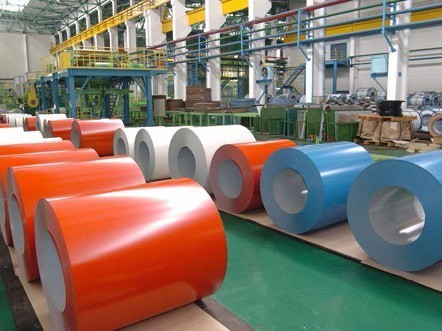
(1) Pre-treatment: The substrate is cleaned to remove surface impurities, rust, and oils. A chemical coating treatment is then applied to the clean substrate surface to enhance adhesion between the substrate and the coating, ensuring that the subsequent coating adheres firmly to the steel sheet surface.
(2) Coating: The most commonly used coating method is the roller coating method. Paint is transferred from the paint tray to the coating roller via a feed roller, forming a wet film of a certain thickness on the coating roller. This wet film is then transferred to the substrate surface. The coating thickness is controlled within a certain range by adjusting the roller gap, pressure, and roller speed. The coating applied using the roller coating method is highly uniform.
(3) Curing and baking: The coating undergoes chemical reactions such as condensation, polymerisation, and cross-linking at a certain temperature and under other conditions, transforming from a liquid state to a solid state. Curing not only firmly bonds the coating to the steel plate but also imparts certain mechanical and physical properties to it. Currently, the market typically uses a two-coat, two-bake process where both sides are coated simultaneously.
(4) Post-processing: This includes processes such as embossing, printing, and lamination, as well as waxing or applying protective films. These treatments enhance the corrosion resistance of the colour-coated steel sheet and protect it from scratches during handling or processing.
(1) Aesthetic appeal: Colour-coated steel sheets offer a wide range of colour and gloss options, allowing customisation to suit different needs and scenarios, thereby enhancing the aesthetic appeal and personalisation of buildings or products.
(2) Corrosion resistance: The coloured coating on the surface of colour-coated steel sheets has excellent corrosion resistance, effectively withstanding corrosive agents in the atmosphere and extending the service life of the steel sheet.
(3) Processability: Coloured steel plates have good plasticity and processability, making them easy to cut, bend, and punch, meeting the needs of various complex shapes.
(4) Environmental friendliness: With the rise in environmental awareness, manufacturers of coloured steel plates have begun to use environmentally friendly coatings and production processes, reducing pollution emissions during production and making coloured steel plates more environmentally friendly.
The coating of colour-coated steel sheets is a key factor determining their appearance and durability.
The types of primer include epoxy resin, polyester resin, acrylic resin, and polyurethane resin, which provide basic protection for colour-coated steel sheets. The topcoat has multiple options, such as ordinary polyester (PE), silicone-modified polyester (SMP), and high-durability polyester (HDP), which not only affect the aesthetic appeal of colour-coated steel sheets but also significantly impact their durability. Additionally, polyvinyl chloride (PVC), polyvinylidene fluoride (PVDF), and acrylic resins are also common topcoat materials. In terms of colour and gloss, colour-coated steel sheets can be selected based on the manufacturer's standard colours or customised to meet specific customer requirements.
Due to their performance advantages, colour-coated steel sheets are widely used in the following fields:
- Roofs and walls: Commonly used in the enclosing structures of large-span buildings such as industrial plants, warehouses, and sports venues, with construction efficiency improved by over 50% compared to traditional materials.
- Partitions and ceilings: Colour-coated steel plates are used for partition walls in offices, hospitals, and other facilities, offering both fire resistance (some models have a fire resistance rating of up to 1 hour) and sound insulation properties.
- Temporary structures: Construction site mobile homes, disaster relief tents, etc., which are cost-effective due to their reusable and disassemblable design, reducing costs by 30%–40%.
- Refrigerator and washing machine casings often use colour-coated steel sheets, which are rust-resistant and easy to clean.
- Cabinets, filing cabinets, and other furniture use colour-coated steel panels for their surfaces, offering both aesthetic appeal and durability.
- Colour-coated steel panels are commonly used for interior panels in high-speed rail and metro carriages, offering lightweight properties and compliance with fire safety standards (e.g., EN 45545-2).
- Using colour-coated steel panels for truck bodies can reduce weight by 15% to 20%, thereby lowering fuel consumption.
Proper storage and transportation are crucial for maintaining the good condition of coloured steel sheets.
During storage, ensure that the sheets are kept in a dry, well-ventilated indoor environment to prevent condensation and corrosion caused by moisture. Additionally, avoid placing heavy objects on top of the sheets to prevent deformation.
During transportation, use specialised lifting equipment and protective devices to safeguard the sheets, ensuring their packaging remains intact and avoiding any damage. Furthermore, proper stacking is essential to prevent deformation and damage caused by excessive stacking heights.
With the continuous advancement of technology, the development of coloured steel sheets is also showing some new trends.
Firstly, high-quality substrate materials are being widely adopted to enhance the surface quality, sheet shape, and dimensional accuracy of coloured steel sheets. Secondly, pre-treatment processes are being continuously improved to enhance their stability and environmental performance. Furthermore, the development of new coatings is a key direction for the industry, aiming to improve colour reproduction, weather resistance, and corrosion resistance. Additionally, the adoption of new equipment such as welding machines, roller coating machines, and curing ovens has made the production of colour-coated steel sheets more efficient and automated. In the future, with further technological advancements, we anticipate that colour-coated steel sheets will evolve towards greater diversity and functionality.
(1) Are colour-coated steel plates environmentally friendly? Answer: The outer layer of colour-coated steel plates uses environmentally friendly zinc-iron alloy coating materials, which do not contain harmful substances; the internal insulation materials are odourless and comply with national environmental standards.
(2) Are colour-coated steel plates fire-resistant? Answer: When storing flammable items, additional fire-prevention measures are recommended; however, if filled with inorganic insulation materials, they can achieve fire-resistant or non-flammable properties.
(3) Does the installation of colour-coated steel sheets require professional technical expertise? Answer: The installation of colour-coated steel sheets requires certain professional knowledge and technical skills, and it is best to have them installed by a professional construction team.
(4) Can colour-coated steel sheets be used long-term? Answer: Colour-coated steel sheets undergo certain corrosion-resistant treatments and can be used long-term under normal usage conditions.
With the continuous advancement of technology, the production techniques and surface treatment technologies for colour-coated steel plates are also undergoing constant improvement and innovation. This will enable colour-coated steel plates to demonstrate superior performance in terms of environmental protection, energy efficiency, and operational effectiveness. Additionally, their surface treatments will become more diverse, aesthetically pleasing, and customisable to meet the needs of various industries and users, thereby expanding the application prospects for colour-coated steel plates.
China galvanized plate manufacturer: Boxing Shuangshengda Steel specializes in galvanized sheet, galvanized steel plate,Colour steel plate etc.We have a full range of product specifications and types, low prices, and more than 20 years of experience, worthy of your trust
 Address:Bo Xing County, Shandong Province
 E-mail: