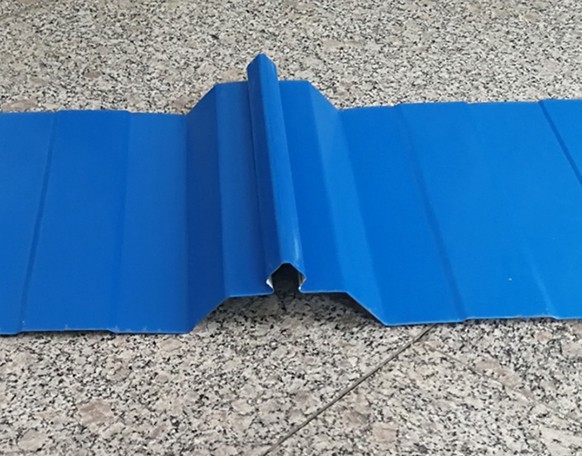
As the most widely used lightweight roofing material in modern architecture, color steel tiles dominate in industrial plants, warehousing and logistics, public facilities and other fields due to their lightweight, high strength, and convenient construction characteristics. However, its core material is galvanized steel plate or aluminum zinc coated steel plate, and although the organic coating on the surface can provide basic protection, it still faces the risk of corrosion under complex environmental factors. This article will systematically analyze the causes and solutions of rusting of color steel tiles from three dimensions: material characteristics, environmental effects, and protective mechanisms.
1. The physical and chemical basis of rusting of color steel tiles
1.1 Material composition and corrosion mechanism
The base material of the color steel tile is cold-rolled steel plate, and an anti-corrosion layer is formed by hot-dip galvanizing (zinc layer thickness ≥ 20 μ m) or aluminum zinc plating (aluminum content 55%, zinc 1.6%, silicon 1.4%) process. The surface coating is usually made of polyester, silicon modified polyester or fluorocarbon resin, with a thickness between 20-25 μ m. The corrosion process follows the principle of electrochemistry: when the coating is damaged and the substrate is exposed, iron reacts with moisture and oxygen in the environment to form a microbattery, generating reddish brown rust mainly composed of Fe ? O ∝· nH ? O.
1.2 Critical conditions for coating failure
Experimental data shows that when the adhesion of the coating decreases to 3-5N/mm 2 (initial value 8-12N/mm 2), the corrosion rate increases exponentially. Environmental temperature and humidity are key factors: when the relative humidity exceeds 70%, moisture condenses in the coating micropores to form electrolyte; For every 10 ℃ increase in temperature, the chemical reaction rate increases by 2-3 times.
2. The core factors affecting the corrosion of color steel tiles
2.1 Environmental erosion factors
1. Chemical corrosion: When the concentration of SO ? in the air of industrial areas exceeds 0.05mg/m 3, it will react with moisture to generate sulfuric acid, accelerating the corrosion process. When the concentration of Cl ? in coastal areas exceeds 0.5%, the consumption rate of zinc layer increases by four times.
2. Mechanical damage: Hail impact (speed>20m/s) can cause microcracks with a diameter of 0.5-2mm in the coating, providing a penetration channel for corrosive media.
3. Biological erosion: Organic acids secreted by certain fungi can cause the pH value of the coating to drop below 4, leading to chemical degradation.

2.2 Design and construction defects
1. Drainage system failure: When the roof slope is less than 5 °, the consumption rate of zinc layer in the flooded area is 6-8 times that of the normal area. Improper design of the gutter can lead to poor drainage and create a continuous electrolytic environment.
2. Corrosion of fasteners: Ordinary carbon steel screws will rust after 72 hours in a salt spray environment. It is recommended to use 304 stainless steel or hot-dip galvanized screws (zinc layer thickness ≥ 5 μ m).
3. Improper joint treatment: When the longitudinal overlap width is less than 150mm, the probability of rainwater infiltration increases threefold; The annual corrosion depth at the joint without sealant can reach 0.1-0.2mm.
2.3 Maintenance and management deficiencies
1. Regular inspection deficiency: Roofs that have not undergone annual professional testing have a 42% probability of severe corrosion within 5 years.
2. Delayed cleaning: When the dust accumulation thickness exceeds 2mm, the surface temperature of the coating can be 8-10 ℃ higher than the clean state, accelerating aging.
3. Delayed repair: Corrosion points with a diameter greater than 3mm that have not been treated can expand to a corrosion zone with a diameter of 10cm within 3 years.
3. Anti rust technology system for color steel tiles
3.1 Material selection optimization
1. Substrate upgrade: The use of aluminum zinc coated steel plate (AZ150) improves the corrosion resistance by 3-5 times compared to ordinary hot-dip galvanized steel plate, and can last for more than 20 years in C5 level corrosive environments.
2. Coating innovation: The weather resistance of fluorocarbon coating (PVDF) is twice that of polyester coating, and the salt spray test can reach 5000 hours without corrosion.
3. Functional coating: Nano TiO ? self-cleaning coating can make the surface contact angle greater than 150 °, reducing the adhesion of pollutants.
3.2 Construction process control
1. Pre treatment standard: Sandblasting treatment should reach Sa2.5 level, with a surface roughness of 40-70 μ m to ensure coating adhesion.
2. Coating parameters: air spray pressure 0.4-0.6MPa, ambient temperature 5-35 ℃, relative humidity<85%.
3. Curing process: Polyester coating needs to be baked at 180 ℃ for 15 minutes, and fluorocarbon coating needs to be baked at 230 ℃ for 20 minutes to ensure complete cross-linking.
3.3 Upgrade of Protection Technology
1. Electrochemical protection: The sacrificial anode method uses magnesium alloy anodes, which can achieve a protection current efficiency of over 95%.
2. Cold spray zinc technology: The deposition efficiency of zinc wire is greater than 85%, forming a pure zinc layer thickness of up to 100 μ m, and the salt spray resistance time exceeds 3000 hours.
3. Nano modified coating: Adding flake zinc powder to the coating can increase shielding effect by 40% and reduce corrosion current by 60%.

4. Full lifecycle maintenance strategy
4.1 Testing and Evaluation System
1. Macro inspection: Use drones for annual aerial photography to identify defects such as deformation and joint cracking.
2. Microscopic detection: Using electrochemical impedance spectroscopy (EIS) technology, coating failure can be predicted 6-12 months in advance.
3. Thickness measurement: The magnetic thickness gauge detects the remaining thickness of the zinc layer, with a critical value set at 30% of the initial thickness.
4.2 Technical specifications for repair
1. Local treatment: Rust spots with a diameter less than 50mm are polished to St3 level using electric tools and coated with zinc rich primer (dry film thickness ≥ 60 μ m).
2. Overall renovation: When the corrosion area is greater than 15%, sandblasting treatment should be carried out before repainting, and a system compatible with the original coating should be selected.
3. Seam sealing: using polysulfide sealant, with a tensile strength of ≥ 1.5MPa and a fracture elongation of ≥ 400%.
4.3 Intelligent monitoring system
1. IoT sensors: Deploy temperature, humidity, and corrosion rate monitoring nodes, and upload data to the cloud platform for warning analysis.
2. Unmanned aerial vehicle inspection: Equipped with a multispectral camera, it can identify rust spots with a diameter of 2mm or more, with an efficiency 10 times higher than manual inspection.
3. BIM model integration: Establish a digital twin to achieve traceable management of maintenance records.
It cannot be generalized whether color steel tiles will rust. In an ideal state, when high-quality substrates are paired with good coatings, in a dry, non corrosive gas environment, and properly maintained, color steel tiles are not easy to rust and can maintain their beauty and performance for a long time, providing shelter from wind and rain for buildings. However, if the substrate material is poor, the coating quality is poor, and it is in a humid environment with chemical corrosion substances, and lacks maintenance, rusting is difficult to avoid. So, in order to prevent color steel tiles from rusting, it is necessary to start from multiple aspects such as material selection, installation environment control, and daily maintenance, so as to enable color steel tiles to play their advantages for a long time.

 Language


 Address:Bo Xing County, Shandong Province
 E-mail: